
Most thrift hauls look better in the store than they do at home. You carry in a chipped pitcher, three mismatched frames and a lace doily, set them down, and the room just looks busier.
The problem is rarely the finds. It’s the styling. Secondhand pieces need a little structure around them, or they read as clutter instead of a collected look.
That’s what this list is for. Here are 16 thrift decor ideas that look straight out of a magazine, and every one starts with something secondhand from a local shop, a yard sale, or the back shelf of a church sale.
Some ideas take ten minutes. A couple need a staple gun or a can of paint. None of them need a big budget or a trained eye, just a bit of patience while you hunt and a willingness to move things around until they feel right.
Turn Mismatched Frames Into a Salon Style Gallery Wall

Look closely at any gallery wall you’ve saved and check the frames. Almost none of them match. Gold sits next to walnut, a round plate hangs beside a tall botanical print, and one tiny oval is tucked under a big landscape. The wall works because the pieces share a mood, not a finish.
Start with these three moves:
- Pick one subject, like flowers, landscapes or old portraits
- Mix at least two frame shapes, such as square, oval and round
- Hang a small plate or brass piece between the frames for texture
Keep the gaps between pieces close and even, about two inches, so the whole wall reads as one group.
Style a Chipped Pitcher as Your New Favorite Vase
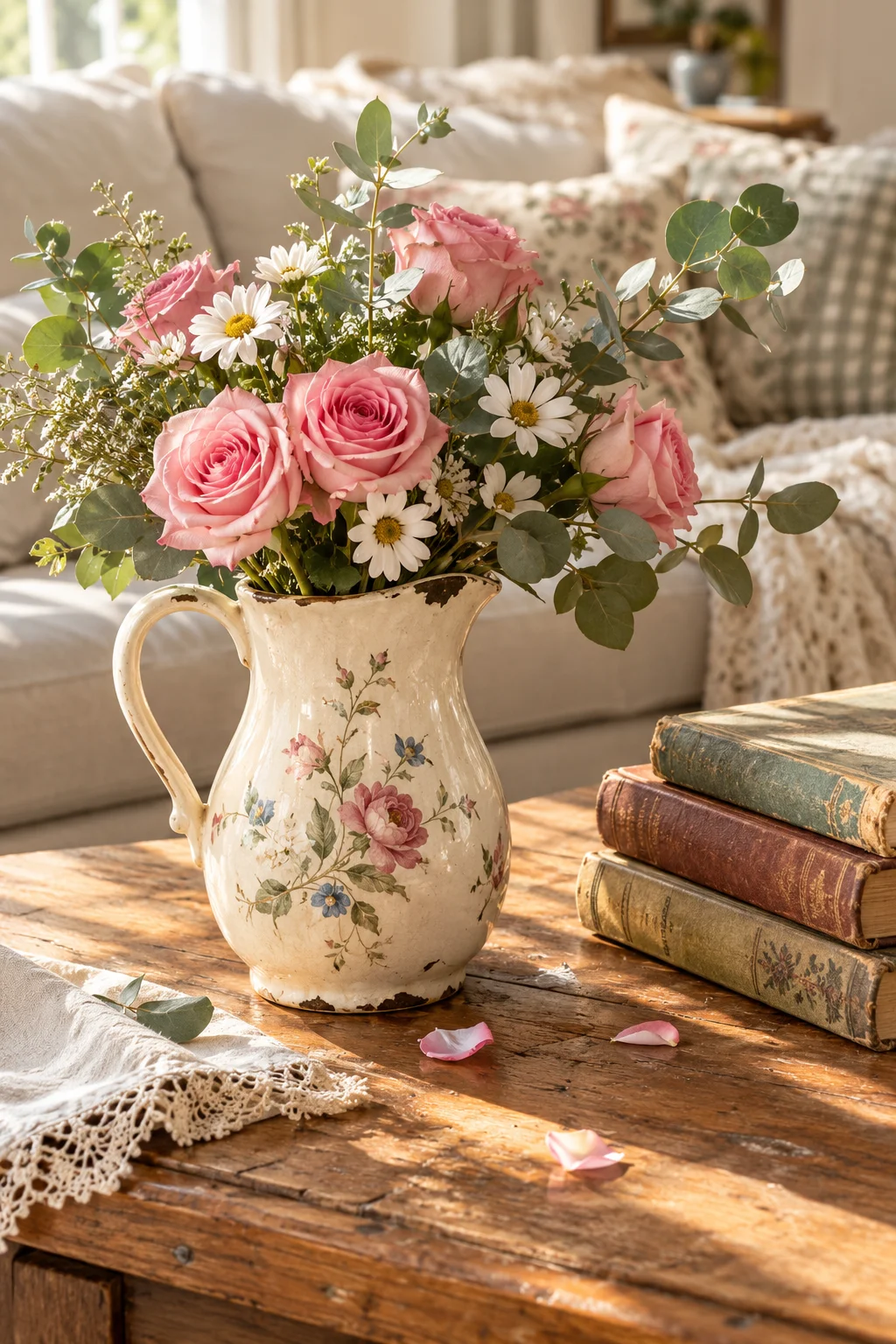
A chip on the rim is exactly why a good pitcher ends up on the discount shelf.
Turn the chip to the back and nobody will ever see it. Floral ironstone, cream glazed and hand painted pitchers all look at home with a loose handful of flowers, and they suit a shelf better than a matching set of vases. Cut the stems short and let a few lean over the edge. Grocery store blooms, garden clippings, ivy and eucalyptus all work.
Skip the tall, tidy arrangement. A pitcher wants something relaxed and a little uneven.
💡 Quick Tip
Old glaze can seep water through tiny cracks. Fill the pitcher with water, set it on a paper towel, and wait an hour. If the towel gets damp, slip a jam jar inside and put the flowers in that.
Tuck a Crochet Doily Under Every Lamp and Clock
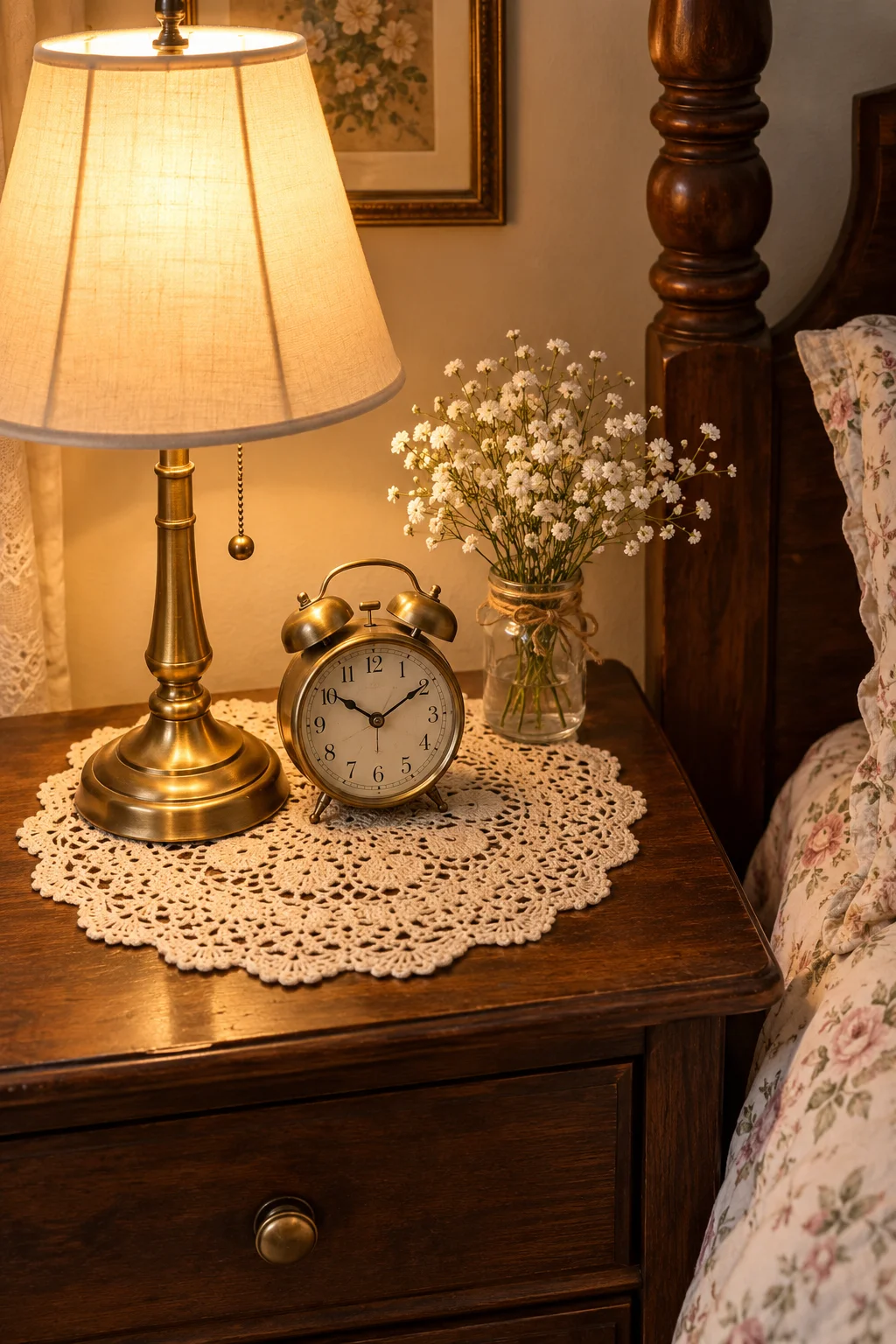
Here’s the one rule for lace: it goes under something, never alone.
A doily on a bare table looks like a leftover. Under a lamp base, an alarm clock and a jar of baby’s breath, it looks like it was always meant to be there. Thrifted crochet is often yellowed or stiff, but most of that washes out. Soak it in warm water with a spoonful of oxygen bleach, rinse, and lay it flat on a towel. Test a hidden corner first.
Pull the edges straight while it’s damp so the scallops dry neat.
A bare nightstand with a lamp, a clock and a jar sitting straight on dark wood. Everything looks a little lost.
One doily under the whole group. It reads as a small still life, and it also stops jar rings and scratches on the wood.
Fill an Old Hutch With Books, Trinkets and a Little Chaos

The usual mistake is arranging a hutch like a store display, with every plate lined up and facing front.
Collected shelves have layers. Put tall things at the back, lay a few books flat to lift a small bowl, and let one plant trail down from the top. Odd numbers of objects look more natural than pairs.
Leave one or two gaps on purpose. A shelf with no breathing room looks crowded, but a shelf with a few empty spots looks chosen.
Shelf layers to gather
Recover Thrifted Dining Chairs in Gingham for a Cottage Nook

The chair that wobbles at the yard sale usually has a good frame and a sad seat. Two bentwood chairs, one red and one soft blue, can carry a whole breakfast corner once the seats are fresh.
If the seat is a drop in pad, follow these steps:
- Unscrew the pad from underneath.
- Lay check fabric over the old foam, leaving about three inches on every side.
- Pull it tight and staple it on the back, then screw the pad back in.
No staple gun? Sew a simple cushion and tie it on with narrow ribbon. Wash the fabric first so it doesn’t shrink later.
Cluster Small Vintage Mirrors Instead of One Big One
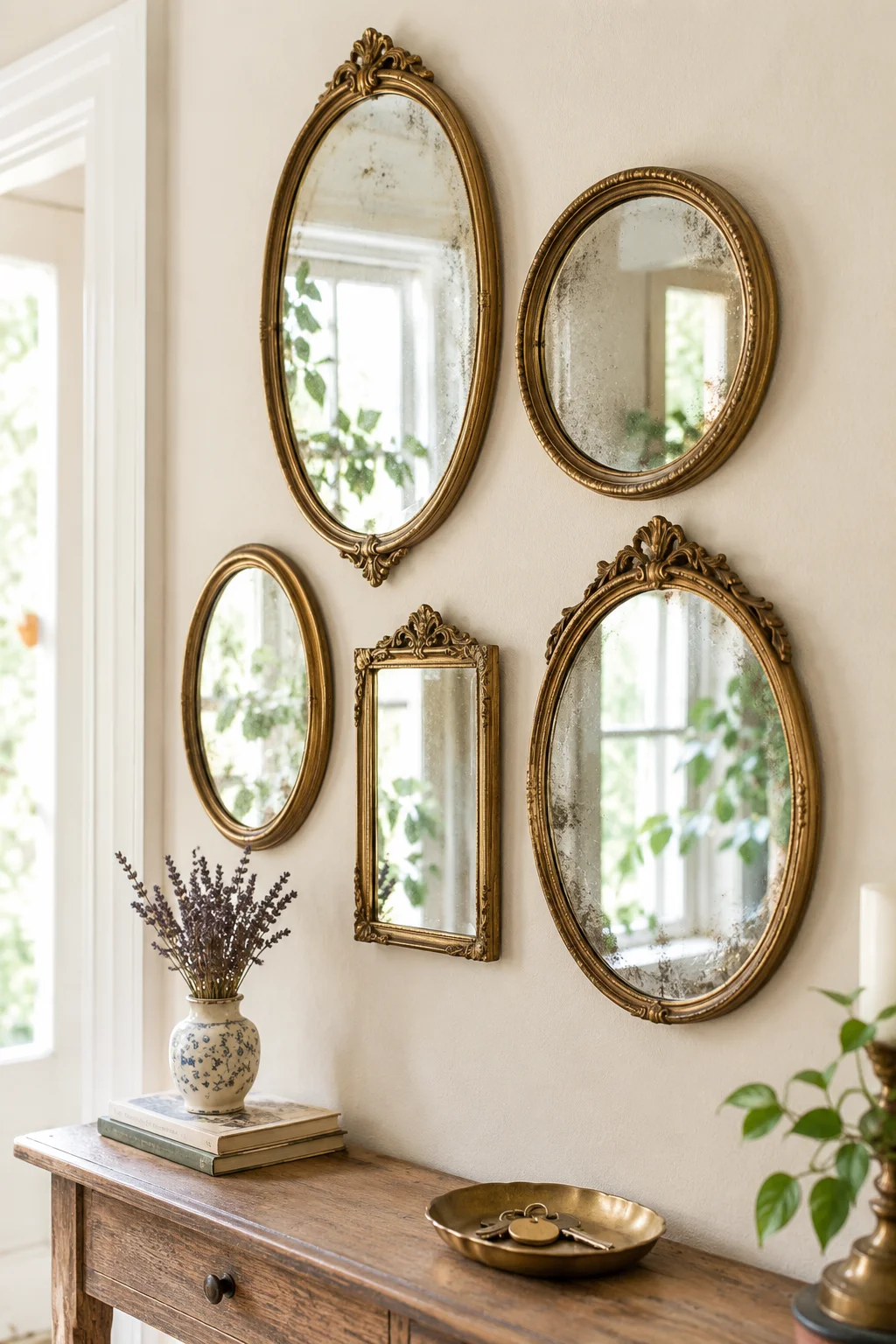
Small mirrors are cheap and easy to find, because almost nobody wants to hang just one tiny oval.
That’s the trick. Gather three to five in different shapes, like an oval, a round and a little rectangle with a worn gold edge, and hang them close together on the wall across from a window. They catch daylight and toss it back into the room, which brightens a dim corner. Wipe the glass with vinegar and water, but leave the cloudy spots where the silvering has aged. Those spots are the charm.
Lay the mirrors on the floor and shuffle them until the gaps look even, about two inches apart.
Trace each one on kraft paper, cut out the shapes, and tape them to the wall so you can judge the layout first.
Hang the middle mirror first, then work outward, swapping each paper shape for real glass.
Let a Brass Candlestick Lamp Be the Star of the Nightstand
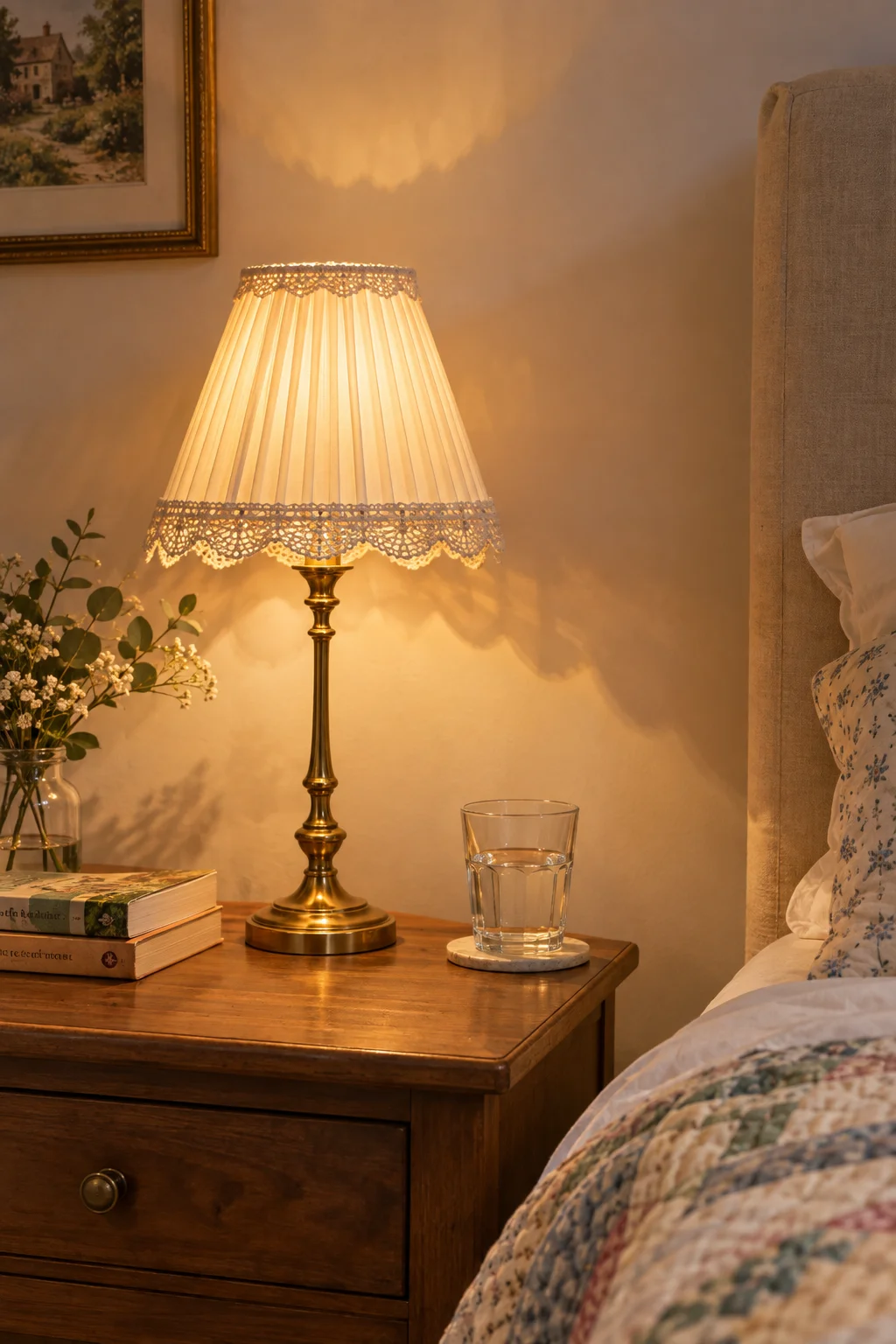
Most thrifted lamps have a good base and a terrible shade.
Keep the brass column and swap in a pleated cream shade, then glue a strip of lace or crochet trim along the bottom edge with fabric glue. Lit at night, the scalloped edge throws a soft pattern on the wall. Before you plug it in, check the cord. If it’s cracked or the plug wobbles, a cheap rewire kit fixes it in minutes. A lamp that sat on a shop shelf for months can hide old wiring.
Clean the base with a soft cloth and mild soap first.
Use a warm white bulb so the trim glows instead of glaring.
Scrubbing with harsh polish. If a magnet sticks to the base, it’s plated and the finish can wear off.
Crowding the table with tall pieces that block the light.
Build a Memory Shelf With Frames, Vases and a Wreath

Hang the wreath first, then build the shelf beneath it.
A wall shelf looks bare until something hangs above it to give the eye a ceiling. A faux floral wreath from the thrift shop does that job for a few dollars. Then load the shelf in two zones. Tall, soft things go at the back, and heavy, dark things stay low and toward the front. Leave a hand’s width between the wreath and your tallest piece.
Small items like a framed quote or a tiny house fill the gaps at the front.
| Back and high | Front and low |
|---|---|
| Wreath, flower pitcher, trailing ivy | Books stacked flat, a small lantern |
| An old clock or a small radio | A framed quote, a tiny bird house |
| Anything airy or soft | Anything heavy or dark |
Anchor a Breakfast Nook With a Scalloped Vintage Style Rug

A round table sits best on a round rug.
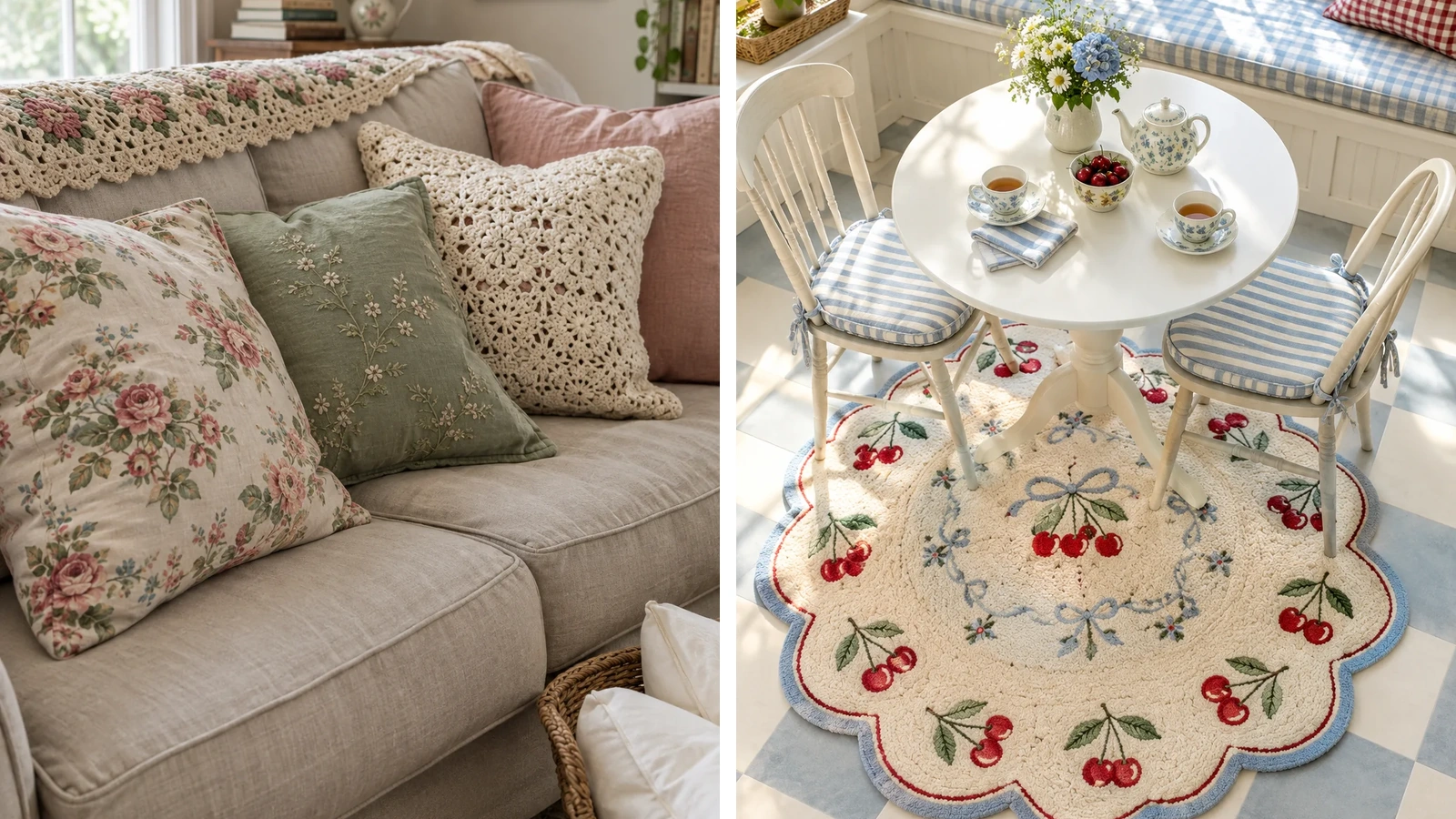
Thrift shops don’t always stock them, so check the back rack and the online listings for hooked, braided or shag styles in cream with one or two accent colors. Measure your table first. You want about two feet of rug past the table edge, so the chairs stay on it when someone pulls out to sit. A wavy edge softens the straight lines of tile and cabinets. If the floor is slick, slide a thin non slip pad underneath.
Rugs that are too small are the number one reason a nook looks off. Take a tape measure and a photo of your table to the shop, so you’re not guessing at the checkout line.
Trade Plain Pillow Covers for Floral and Crochet Thrift Finds

Four pillows in the same print make a sofa look like a showroom set.
Thrift shops sell covers in the linen aisle, often for less than a new insert costs. Buy the cover and slip in inserts you already own. Then mix three kinds on one sofa:
- One busy cover, like a small rose print
- One plain cover in a color pulled from that print, such as sage or dusty pink
- One textured cover, like crochet or hand embroidery
Keep the sizes close so the row looks tidy. This works best on a neutral sofa, where the colors have room to show.
💡 Quick Tip
Thrifted covers often smell like a closet, and old dye can bleed. Press a damp white cloth against a hidden seam first. If color comes off, air the cover outside for a day instead of washing it.
Turn a Farmhouse Coffee Table Into a Book and Candle Ledge
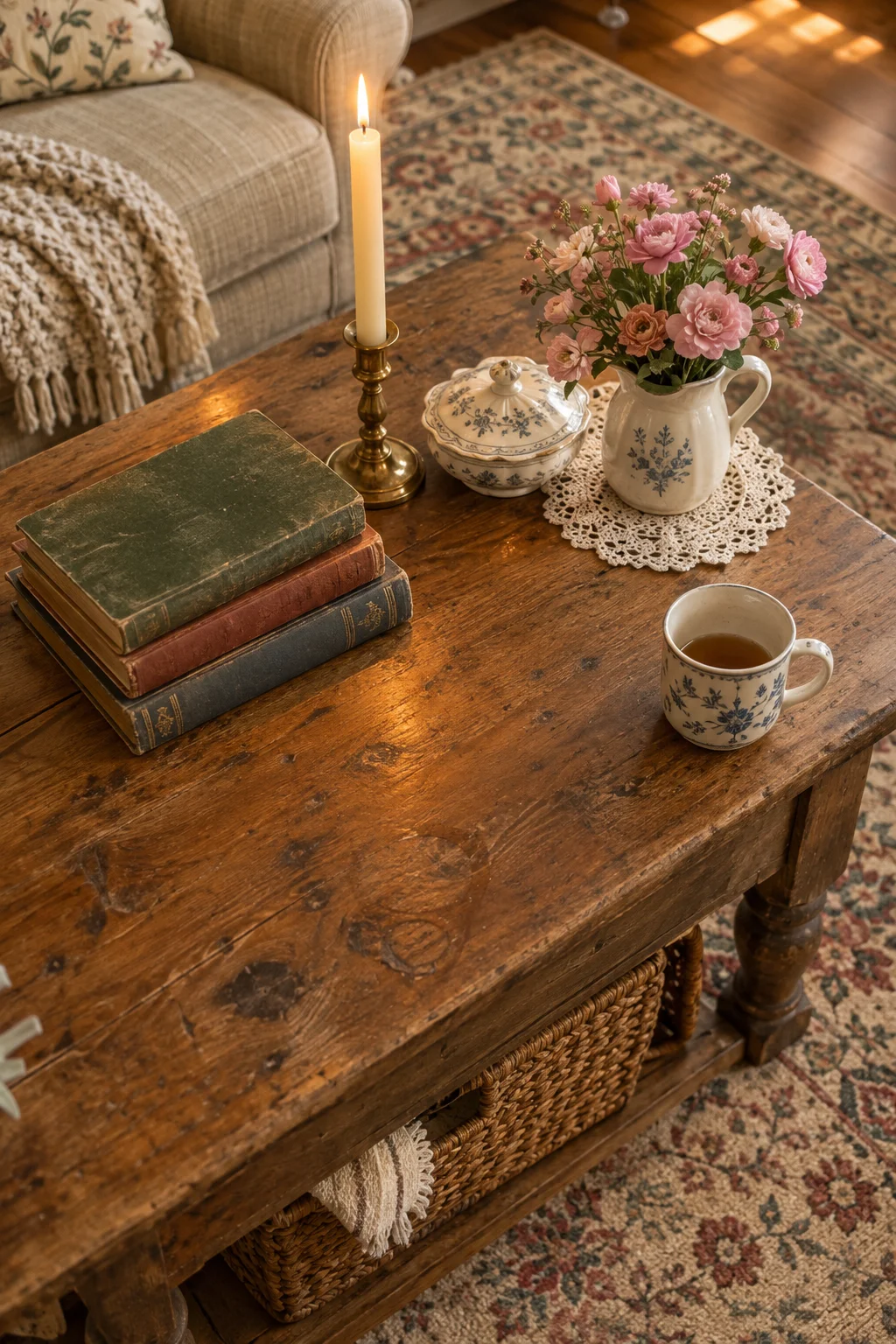
Dents and water rings are the reason a thrifted coffee table works. Leave them alone.
Build a small still life on one half of the top:
- Three books with worn spines, stacked flat
- A tall taper in a brass holder, set beside the stack
- A lidded dish on top of the books for a little height
A woven basket underneath takes the throw blanket and the magazines, so the surface stays clear.
Keep everything on one side, so there’s still room for a mug and a plate of toast.
Hang a Thrifted Basket Planter for Instant Cascading Green
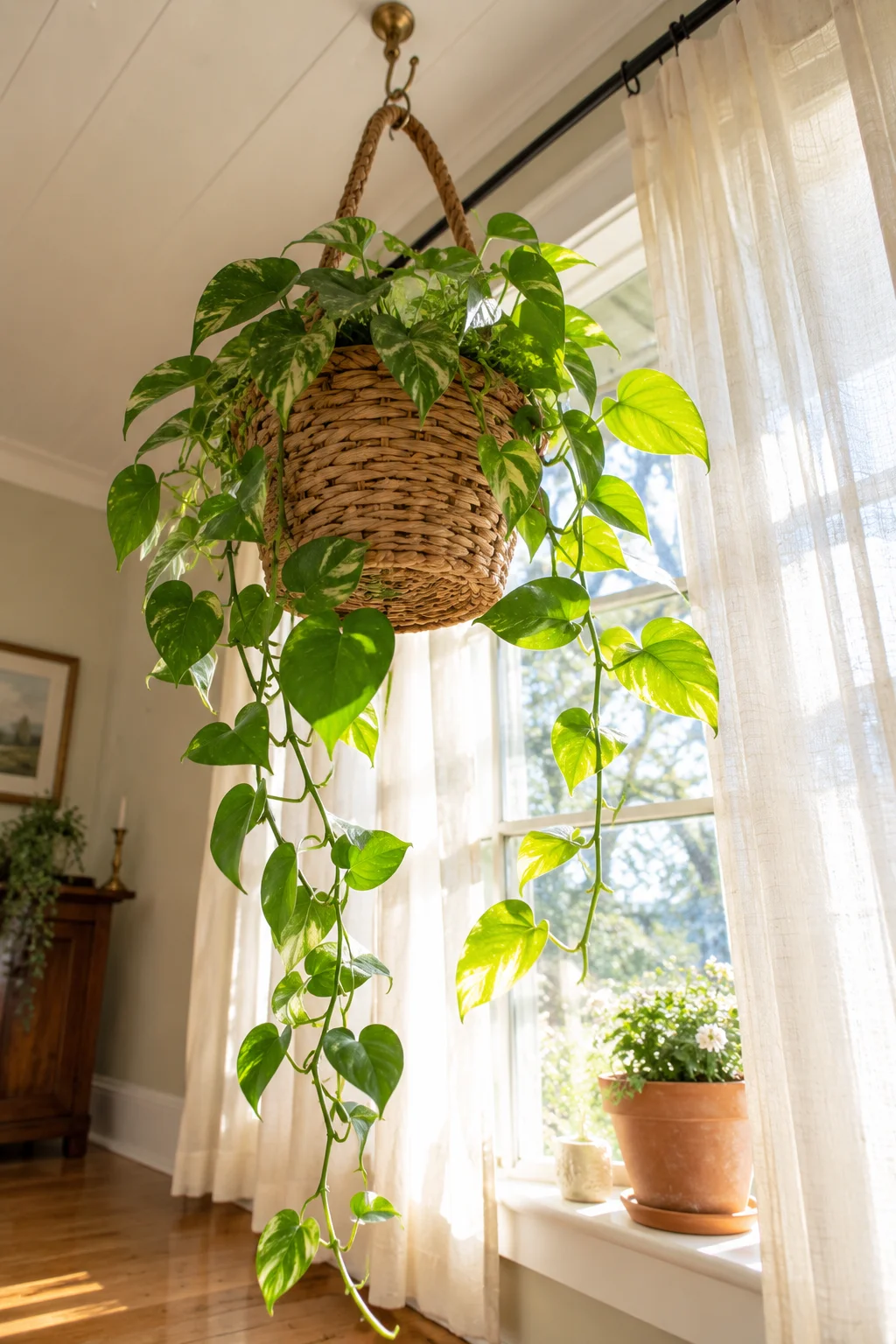
Find a woven basket with a sturdy handle, the kind that once carried laundry or a picnic lunch.
A trailing pothos or ivy sits inside it in a plain plastic nursery pot, so the basket never touches wet soil. Hang it near a bright window and the vines drape over the rim and soften the curtain line. Because the plant grows down instead of out, it takes up no floor or shelf space.
One safe habit before you start: soil holds water, and a watered basket is heavy.
Screw a hook rated for the weight into a ceiling joist. Drywall alone won’t hold a wet basket.
Set the nursery pot on a saucer inside the basket, then tuck moss or a scrap of fabric around the rim.
Hang it, then give it a quarter turn each week so every side gets light.
Stop Hiding the Teacups and Let the Hutch Show Them Off

Teacups stacked behind a closed cabinet door are just dishes nobody uses.
Glass fronts are made to be looked through. Move the prettiest cups to eye level and stand a saucer on its edge behind each one, so the pattern shows. Hang one cup from a small cup hook for variety, and tuck a battery tea light in the corner of the shelf so the china glows in the evening.
Plain white plates you use every day can live on the lower shelves.
Swap a few pieces each season so it never feels like a museum case.
Cups nested in tight stacks, plates leaning together, everything the same shade of white. The glass shows a wall of clutter.
Five or six patterned cups spaced out with saucers behind them, and one small light in the corner. Each piece gets its own moment.
Frame a Botanical Print With a Bow for a Soft Corner Accent
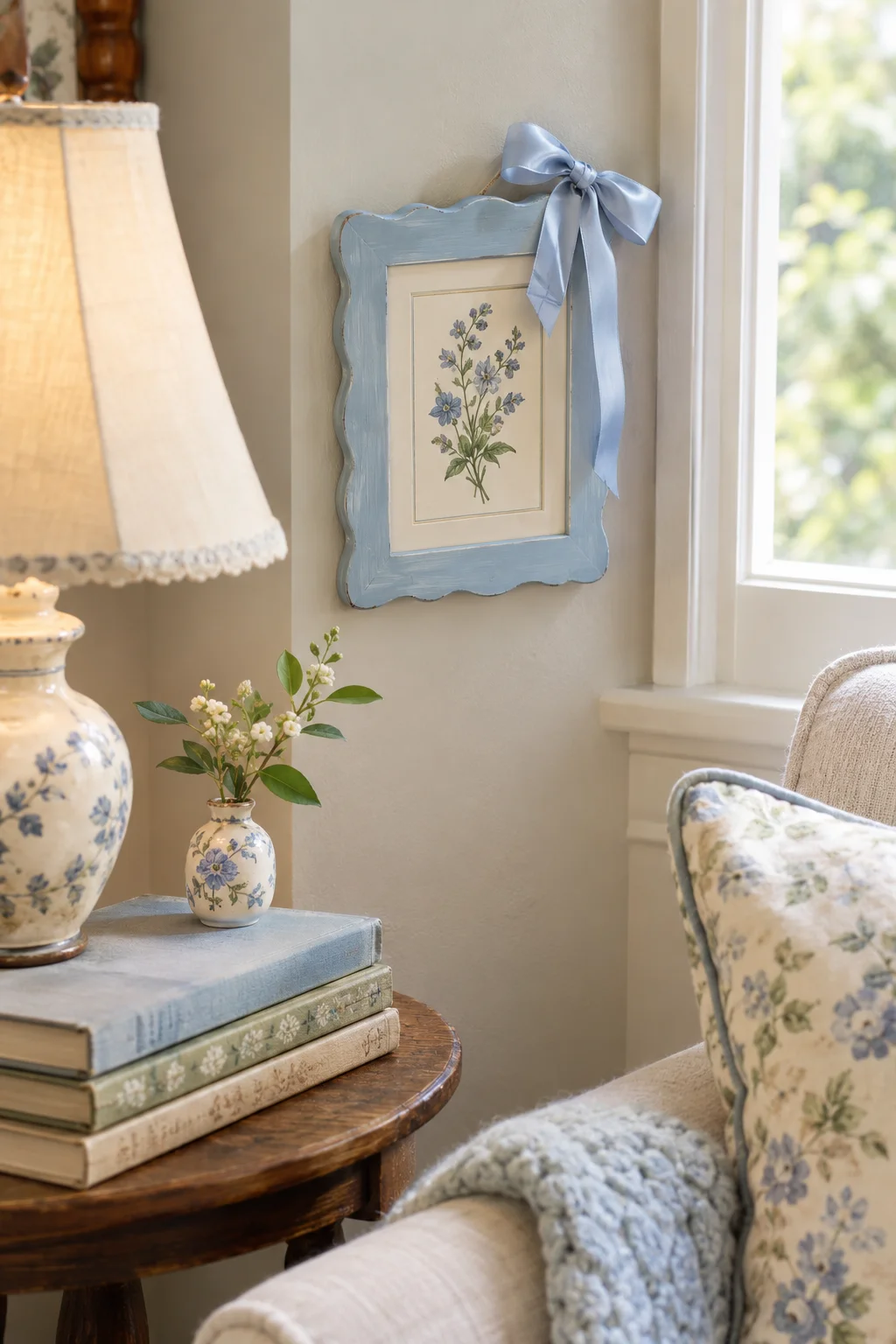
Tiny rule: the frame should be a little louder than the print inside it.
A small botanical or needlework piece in a wavy, scalloped frame gives a bare corner something to look at. Paint a plain thrifted frame in a soft color, then tie a narrow ribbon into a bow and glue it to the top corner, or knot it around the hanging cord.
Hang it low beside a lamp or a window, where the eye lands when someone sits down.
Use light ribbon, since a heavy one can tip the frame forward.
What to gather first
Drape a Vintage Throw Over One Sofa Arm for Texture
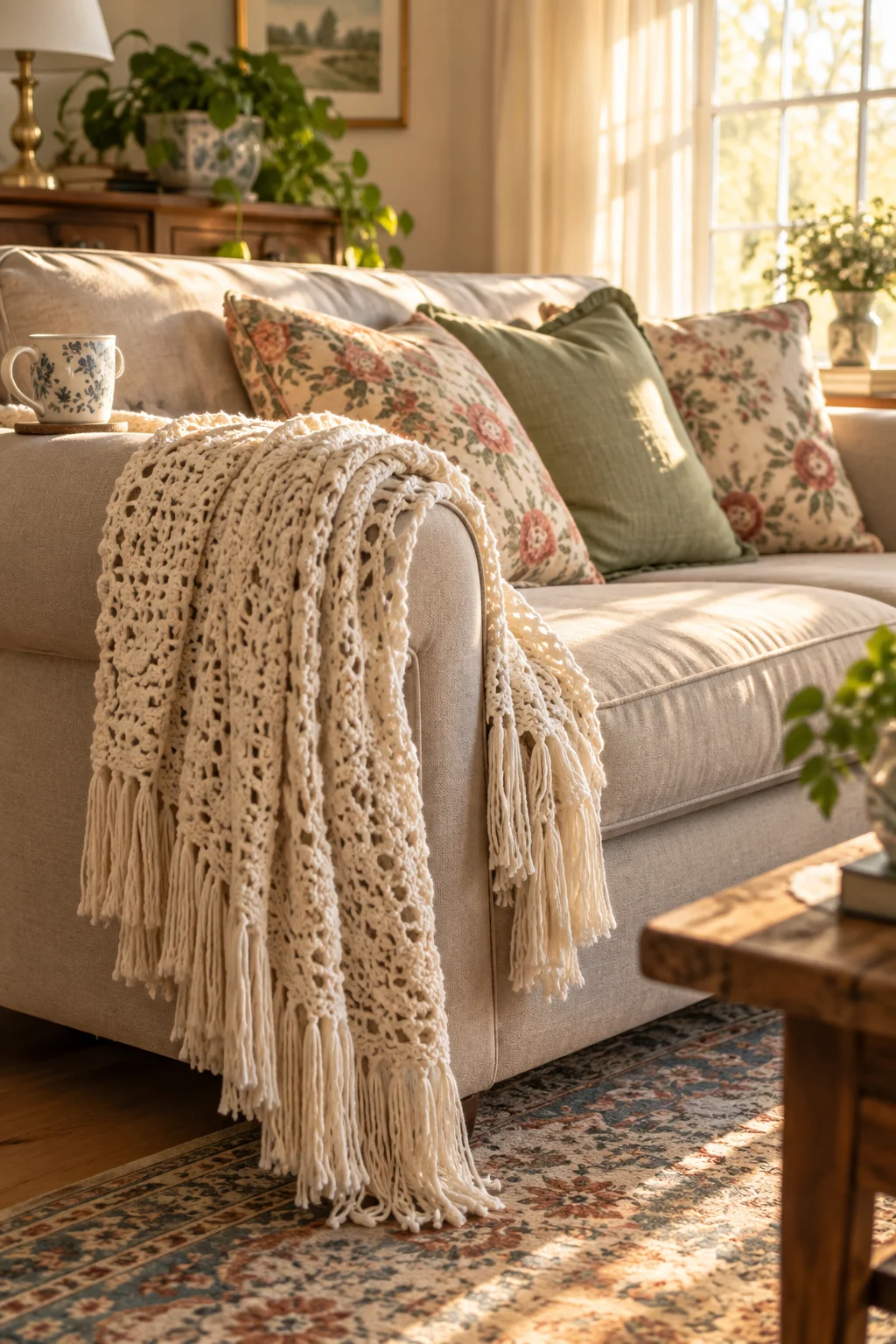
A folded blanket on the seat says guests are welcome. A throw draped over one arm says somebody actually lives here.
Crochet, chunky knit and fringed throws hold a drape best, and thrift shops often sell them for very little. Choose one in a color already in your pillows. Let it fall about a third of the way down the cushions, and leave the fringe hanging free.
Keep it to one throw per sofa. Two starts to look like laundry.
Pick a throw in a color that repeats in a pillow.
Air it outside for a day, or wash it gently, before it goes on the sofa.
Folding it into a neat square on the arm, where it looks stiff.
Machine washing wool on hot, since it can shrink.
Repaint a Bentwood Chair in a Bold Color to Anchor the Room
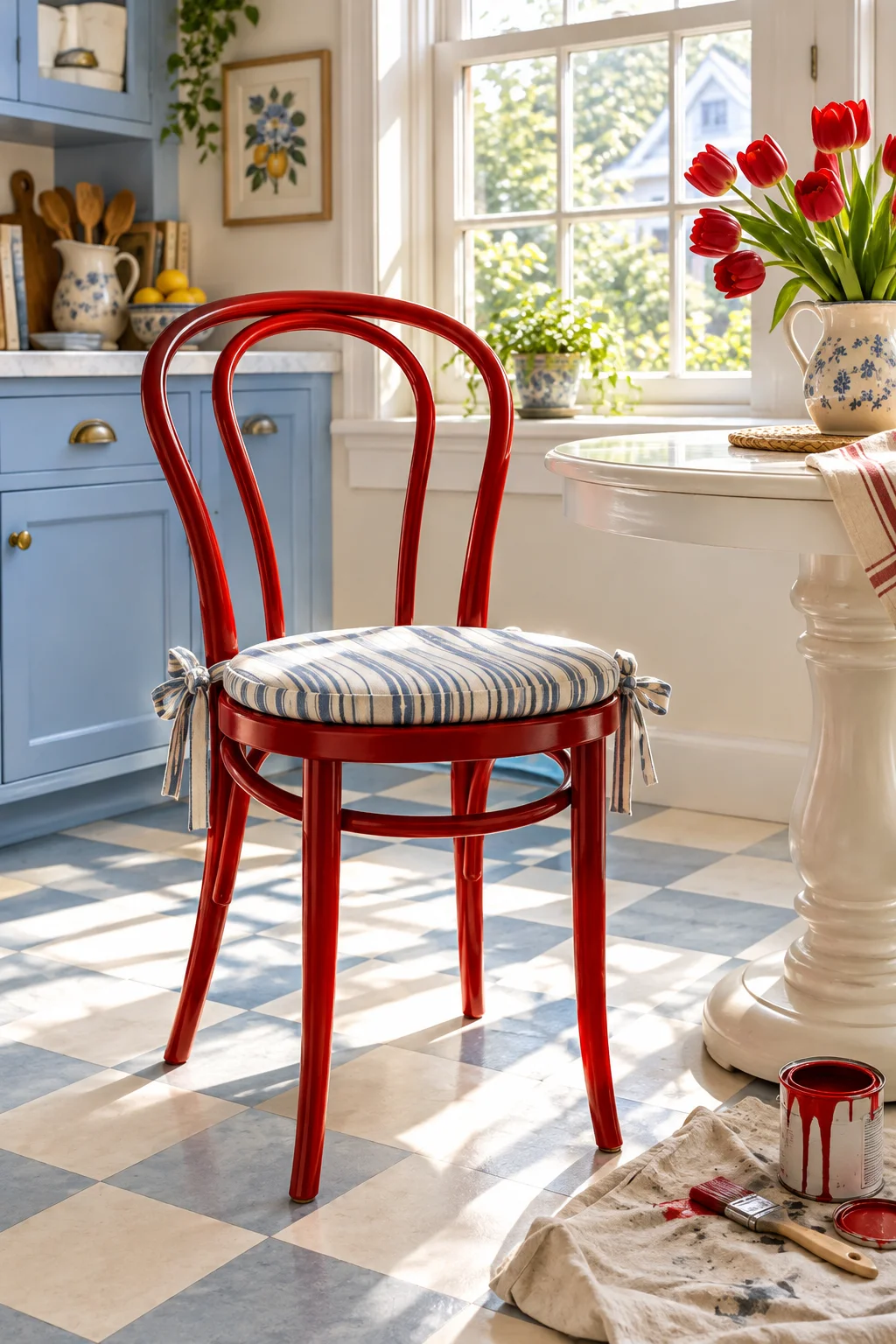
A room full of soft florals needs one loud thing, or it drifts into beige.
One painted chair does that job. Pick a red, a deep blue or a sky blue that already shows up in a pillow or a rug, and paint a single chair instead of the whole set. Park it beside a table, under a window, or at the end of a hallway where you can see it from across the room. Bentwood chairs are the best candidates, since the curved legs catch the light and the wood takes paint well.
Let the paint cure for a few days before anyone sits down.
- ▸Sand lightly with fine grit paper, just enough to dull the shine.
- ▸Wipe off the dust with a damp cloth and let the wood dry.
- ▸Brush on a bonding primer, then two thin coats of paint instead of one thick coat that drips.
- ▸Finish with a clear satin sealer so the seat rail and back hold up to daily use.
- ▸Chair from before 1978? Test the old paint with a lead check kit before you sand.
Conclusion
You don’t need a big budget or a car full of furniture to get a room that feels collected. A few frames, a pitcher of flowers, a doily under the lamp and one bold chair go a long way.
The thrift decor ideas that look straight out of a magazine all follow the same habit. Pick pieces you actually like, group them with care, and leave a little space around each one.
Start with the corner you look at most, then add one more idea each time you find something good on a shelf. Save this list for your next thrift run, so it’s on your phone when you’re standing in the aisle holding a chipped pitcher and wondering what to do with it.